GBA vs DS: Which Handheld Had the Better Game Library?
The Short Answer: Which Library Wins?
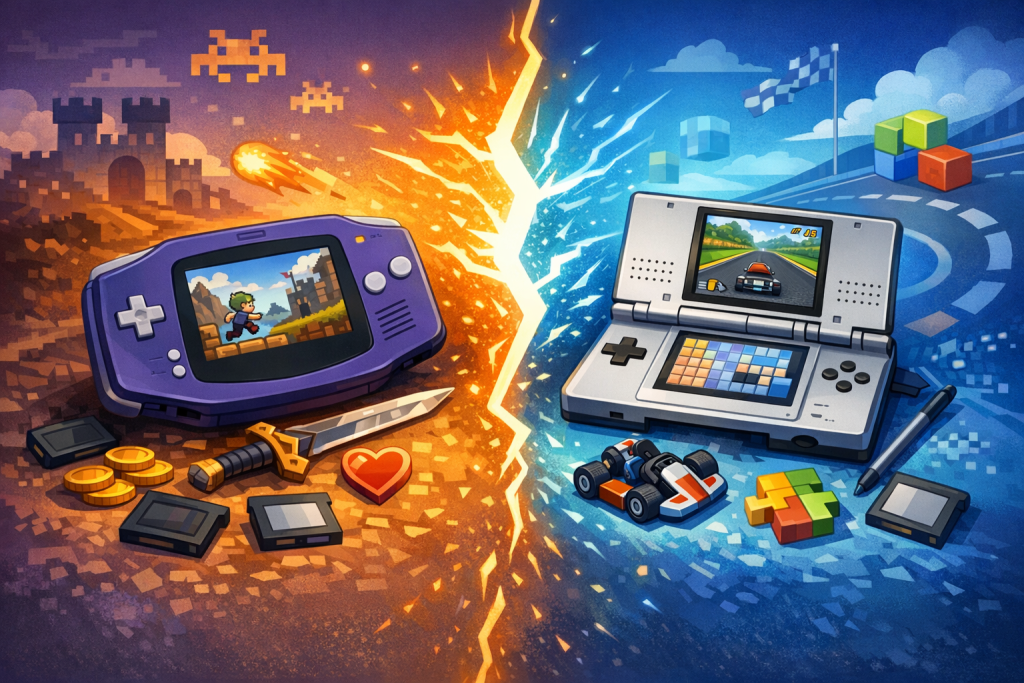
The Nintendo DS had the better overall library by most metrics — more titles (over 1,800 vs roughly 1,050 for GBA), broader genre diversity, and stronger first-party output — but the Game Boy Advance had a denser concentration of all-time classic 2D platformers, RPGs, and Castlevania/Metroidvania-style games. If you value depth of catalog and innovation, DS wins; if you value polished 2D sprite work, GBA edges ahead.
Both systems sold spectacularly. The GBA moved roughly 81.5 million units between 2001 and its quiet 2010 discontinuation. The DS family (DS, DS Lite, DSi, DSi XL) sold over 154 million, making it the second best-selling gaming device ever after the PlayStation 2. That commercial gap explains a lot: more units sold means more publisher investment, more localized titles, and a wider experimental fringe — which is exactly where the DS thrived.
Library Size, Release Window, and Output Tempo
The GBA had a roughly 7-year active commercial life (2001–2008 in the West) and produced around 1,050 distinct retail games. The DS had a roughly 9-year active life (2004–2013) and produced over 1,800 retail titles plus hundreds of DSiWare downloads, giving it nearly double the catalog size and a much wider experimental tail.
Yearly Release Density
- GBA peak years: 2002–2004, when Nintendo, Capcom, and Konami were still committed to the platform alongside the GameCube.
- DS peak years: 2006–2009, when third parties like Atlus, Square Enix, Level-5, and Cing produced some of the most distinctive software ever released on a Nintendo handheld.
- Cross-generation overlap: From late 2004 through 2006, GBA and DS coexisted — the DS originally being marketed as a “third pillar” rather than the GBA’s successor.
Quantity vs Quality
Raw catalog size favors the DS, but raw size includes a long tail of shovelware: licensed movie tie-ins, Imagine: Babyz-style casual titles, and quiz games that ballooned the count without raising quality. If you filter for Metacritic scores above 85, the GBA punches surprisingly close to the DS despite half the library.
Reading on a phone? Why not playing on it?
EMUverse turns your iPhone into a powerful GBA console with HD video, save states, and custom skins.
Install Now — Free
First-Party Output: Nintendo’s Heavy Hitters
Nintendo’s internal studios delivered stronger first-party headliners on the DS, particularly in the Mario, Zelda, Pokémon, and Animal Crossing lines. The GBA’s first-party catalog leaned heavily on ports and remakes from the Super NES era, while the DS delivered original entries that defined franchises for a decade.
GBA First-Party Highlights
- The Legend of Zelda: The Minish Cap (2004) — arguably the best top-down Zelda since A Link to the Past.
- Metroid Fusion (2002) and Metroid: Zero Mission (2004) — two of the most refined 2D Metroid entries.
- Mario & Luigi: Superstar Saga (2003) — launched the entire M&L subseries.
- Wario Land 4 (2001) and WarioWare, Inc.: Mega Microgame$! (2003) — defining quirky Nintendo design.
- Fire Emblem (2003) and Fire Emblem: The Sacred Stones (2004) — the series’ Western debut.
- Pokémon Ruby/Sapphire/Emerald/FireRed/LeafGreen — the Gen III generation.
- Advance Wars (2001) and Advance Wars 2: Black Hole Rising (2003) — peak turn-based strategy.
DS First-Party Highlights
- New Super Mario Bros. (2006) — revived 2D Mario after a 14-year absence and sold over 30 million copies.
- Super Mario 64 DS (2004) — launch-window 3D platformer with bonus content.
- The Legend of Zelda: Phantom Hourglass (2007) and Spirit Tracks (2009) — fully stylus-controlled Zelda.
- Mario Kart DS (2005) — the first portable Mario Kart with online multiplayer.
- Pokémon Diamond/Pearl/Platinum/HeartGold/SoulSilver/Black/White — Gens IV and V.
- Animal Crossing: Wild World (2005) — first portable Animal Crossing, redefined the franchise.
- Nintendogs (2005) — over 23 million copies, a cultural phenomenon.
- Brain Age (2005) — sold the DS to adults who’d never owned a console.
- Advance Wars: Dual Strike (2005) and Days of Ruin (2008).
- Kirby Canvas Curse (2005) and Kirby Super Star Ultra (2008).
RPG Libraries: Where Both Systems Shined
RPGs are where both libraries become genuinely competitive. The GBA carried the torch for traditional sprite-based JRPGs at a moment when home consoles were abandoning them, while the DS hosted some of the most ambitious original RPGs ever made on a Nintendo platform, including landmark titles from Square Enix, Atlus, and Mistwalker.
GBA RPG Standouts
- Golden Sun (2001) and Golden Sun: The Lost Age (2002) — Camelot’s two-part epic.
- Final Fantasy Tactics Advance (2003).
- Final Fantasy IV, V, and VI Advance — definitive 2D versions until the pixel remasters.
- Sword of Mana (2003) and Mother 3 (2006, Japan only — but widely fan-translated).
- Tactics Ogre: The Knight of Lodis (2001) and Riviera: The Promised Land (2002).
DS RPG Standouts
- Chrono Trigger DS (2008) — the definitive version with new content.
- Dragon Quest IV, V, and IX — particularly DQIX (2009/2010), one of the best entries in the series.
- The World Ends with You (2007) — Square Enix at its most experimental.
- Final Fantasy III (2006) and IV (2007) 3D remakes.
- Shin Megami Tensei: Devil Survivor (2009), Strange Journey (2009), and the Devil Survivor 2 follow-up.
- Etrian Odyssey I–IV — Atlus’s dungeon-crawler revival.
- Radiant Historia (2010), Solatorobo (2010), Suikoden Tierkreis (2008).
- Mario & Luigi: Partners in Time (2005) and Bowser’s Inside Story (2009).
- Pokémon Conquest (2012) and Pokémon Mystery Dungeon: Explorers of Sky (2009).
If you sort by Metacritic average, the DS RPG library is deeper, broader, and more varied. The GBA’s strength is concentrated in remakes and a handful of original gems; the DS produced multiple new franchises (Etrian Odyssey, TWEWY) that still get sequels today.
Platformers, Action, and 2D Craftsmanship
The GBA hosts arguably the densest collection of high-quality 2D platformers and Metroidvanias ever assembled on a single handheld, while the DS focused on novelty platformers using the touch screen and dual displays. If pixel-art 2D craftsmanship is your benchmark, GBA wins this category decisively.
Castlevania: The Definitive Case Study
The GBA hosts three Castlevania titles — Circle of the Moon (2001), Harmony of Dissonance (2002), and Aria of Sorrow (2003) — with Aria widely considered one of the top three Metroidvania games ever made. The DS counters with Dawn of Sorrow (2005), Portrait of Ruin (2006), and Order of Ecclesia (2008). The DS trilogy is mechanically richer and more ambitious; the GBA trilogy has tighter pixel art. This is a microcosm of the entire library debate.
Other Notable Platformers
- GBA: Sonic Advance 1–3, Mega Man Zero 1–4, Mega Man Battle Network 1–6, Klonoa: Empire of Dreams, Astro Boy: Omega Factor, Ninja Five-O.
- DS: Mega Man ZX and ZX Advent, Sonic Rush, Yoshi’s Island DS, Henry Hatsworth, Contra 4, Mighty Milky Way.
Innovation and Touchscreen Experimentation
The DS dominates in genre innovation thanks to its dual screens, microphone, and resistive touchscreen. Entire categories of games — stylus-driven puzzlers, point-and-click adventures, brain-training, pet sims — only existed because of the DS hardware, and many couldn’t be replicated on the button-only GBA.
Genres the DS Pioneered or Revived
- Visual novels/adventure: Ace Attorney trilogy ports plus new entries, Hotel Dusk: Room 215, Trace Memory, Ghost Trick: Phantom Detective, 999: Nine Hours, Nine Persons, Nine Doors.
- Puzzle adventures: the Professor Layton series (six DS entries, over 17 million copies combined).
- Lifestyle/edutainment: Brain Age, Nintendogs, Cooking Mama.
- Rhythm: Elite Beat Agents, Ouendan, Rhythm Heaven.
- Strategy hybrids: Advance Wars: Dual Strike using both screens.
The GBA, by contrast, had no comparable category-creating titles. Its innovations were largely refinements of existing genres rather than the invention of new ones.
Third-Party Support and Publisher Risk-Taking
Third-party support on the DS was both broader and weirder than on the GBA. Publishers were willing to localize niche Japanese titles for the DS because its installed base was so massive that even a 100,000-unit sale was profitable, leading to a golden age of localizations between 2007 and 2011.
| Publisher | GBA Notable Output | DS Notable Output |
|---|---|---|
| Capcom | Mega Man Battle Network, Zero series | Ace Attorney, Ghost Trick, Mega Man ZX, Phoenix Wright |
| Konami | Castlevania trilogy, Boktai | Castlevania DS trilogy, Tokimeki Memorial |
| Square Enix | FF I–VI Advance, FFTA | TWEWY, Chrono Trigger DS, FF III/IV 3D, DQ IV/V/VI/IX |
| Atlus | Riviera, Tactics Ogre | Etrian Odyssey 1–4, SMT: Strange Journey, Devil Survivor 1–2 |
| Level-5 | None major | Professor Layton series, Inazuma Eleven, Ni no Kuni |
Multiplayer, Online, and Social Features
The DS’s Nintendo Wi-Fi Connection (launched November 2005) was the single most transformative library difference — it enabled global online multiplayer in Mario Kart DS, Pokémon Diamond/Pearl, Tetris DS, and dozens of others. The GBA’s link-cable multiplayer required physical proximity and extra hardware, severely limiting how many games leveraged it.
Pokémon trading and battling exemplify this: GBA-era Pokémon required two cartridges and a link cable; DS-era Pokémon let you trade globally over Wi-Fi via the Global Trade Station. This dramatically extended the practical lifespan of DS Pokémon titles.
Ports, Remakes, and Backward Compatibility
Both libraries lean on classic IP, but in different ways. The GBA was Nintendo’s vehicle for porting Super NES classics (Super Mario World, A Link to the Past, Yoshi’s Island, Donkey Kong Country trilogy), while the DS focused on rebuilding earlier titles in new dimensions (Super Mario 64 DS, FF III/IV 3D remakes, Chrono Trigger DS).
Crucially, the original DS and DS Lite are backward compatible with GBA cartridges through the Slot-2 port — meaning a DS Lite owner effectively had access to both libraries simultaneously. This is one of the strongest practical arguments that “the DS had better games”: it had its own catalog plus the GBA’s. The DSi and DSi XL (2008/2009) dropped this slot, which many fans criticized at the time.
Audio-Visual Presentation: Sprites vs Dual Screens
The GBA’s library benefits from a consistent visual identity — pixel art rendered for a 240×160 screen — that has aged extraordinarily well. The DS’s two 256×192 screens and weak 3D capabilities produced mixed results: stunning 2D titles like Mario & Luigi: Bowser’s Inside Story sit alongside muddy early 3D efforts that look dated today.
This matters for library quality because GBA games tend to look as good now as they did at launch, while many mid-tier DS games have aged poorly visually. The best DS titles, however, still impress — Ghost Trick’s animation in particular remains a benchmark for handheld 2D.
Common Mistakes When Comparing the Two Libraries
Many comparisons go wrong because they compare unequal samples or ignore the historical context in which each system launched. Avoid the following pitfalls when forming your own opinion.
- Counting shovelware equally: The DS has more total games partly because it has more bad games. Filter by critical reception.
- Ignoring the GBA’s overlap years: 2005–2007 GBA titles were often afterthoughts as publishers shifted to DS.
- Forgetting region exclusives: Japan-only releases skew library counts. Mother 3 never officially left Japan.
- Comparing across genre preferences: If you only play 2D platformers, GBA wins. If you play visual novels or strategy RPGs, DS wins.
- Conflating sales with quality: Nintendogs sold 23 million copies but isn’t typically anyone’s “best DS game.”
Verdict: A Genre-By-Genre Scorecard
Reduced to a category scorecard, the DS wins 7 of 10 major genre categories while the GBA wins 3 — but those three (2D platformers, Metroidvanias, traditional JRPGs) are precisely the categories most beloved by enthusiast retro collectors, which is why the debate persists.
| Category | Winner |
|---|---|
| 2D Platformers | GBA |
| Metroidvania | GBA (slightly) |
| Traditional JRPGs | GBA |
| Strategy RPGs | DS |
| Adventure/Visual Novel | DS |
| Puzzle | DS |
| Rhythm | DS |
| Online Multiplayer | DS |
| Pokémon main series | DS |
| First-party Nintendo flagships | DS |
Frequently Asked Questions
Did the GBA or DS have more games total?
The DS had significantly more games — approximately 1,800+ retail titles versus around 1,050 for the Game Boy Advance, not including DSiWare downloads. The DS’s longer commercial life (2004–2013 vs 2001–2008) and massive 154 million unit install base attracted more publishers, including many that produced niche Japanese localizations specifically because the DS audience was large enough to justify the translation cost.
Which system has the best Pokémon games?
This depends on personal preference, but most fan polls rank the DS Pokémon games higher. The DS hosted Diamond/Pearl/Platinum (Gen IV), the HeartGold/SoulSilver remakes (widely considered the best Pokémon games ever), and Black/White/Black 2/White 2 (Gen V). The GBA’s Gen III titles — Ruby/Sapphire/Emerald and the FireRed/LeafGreen remakes — are excellent but lack the online trading, day-night cycles, and physical/special split that define the DS-era Pokémon experience.
Can a DS play GBA games?
Yes — the original Nintendo DS (2004) and DS Lite (2006) both include a Slot-2 cartridge port that accepts and plays Game Boy Advance cartridges natively. However, they cannot play original Game Boy or Game Boy Color games, and they don’t support GBA link-cable multiplayer or e-Reader peripherals. The DSi (2008) and DSi XL (2009) removed the GBA slot entirely, so they cannot play GBA cartridges at all.
Which handheld had better RPGs?
The DS edges ahead on quantity, variety, and ambition, with landmark titles like The World Ends with You, Chrono Trigger DS, Dragon Quest IX, Radiant Historia, and the entire Etrian Odyssey series. The GBA wins on classic 2D JRPG remakes (Final Fantasy IV/V/VI Advance) and original gems like Golden Sun and Mother 3. If you only play one system for RPGs, the DS library is broader; if you prefer pure 16-bit-style RPG aesthetics, the GBA is more focused.
Are GBA games more valuable than DS games today?
Generally yes. GBA cartridges command higher resale prices in 2024 because production ended earlier (limiting supply), the cartridges are smaller and easier to lose or damage, and demand from collectors of Pokémon Emerald, Fire Emblem, Mother 3, and the Castlevania trilogy is unusually high. Loose Pokémon Emerald cartridges routinely sell for $80–150, while comparable DS Pokémon titles sell for $40–80. Sealed and graded copies of GBA games regularly hit four-figure prices.
Which had better Mario games?
The DS, by a clear margin. New Super Mario Bros. (2006) reinvented 2D Mario after a 14-year absence and sold over 30 million copies; Super Mario 64 DS expanded the N64 classic; Mario Kart DS introduced online racing; and Mario & Luigi: Partners in Time and Bowser’s Inside Story extended the RPG subseries. The GBA’s Mario output relied heavily on Super Mario Advance ports of older games, with Mario & Luigi: Superstar Saga as the standout original entry.
Did the DS kill the GBA prematurely?
Partially. Nintendo originally positioned the DS as a “third pillar” alongside the GBA and GameCube, promising continued GBA support. In practice, third-party publishers shifted focus to the DS by mid-2005, and GBA releases dwindled rapidly through 2006–2007. The system was officially discontinued in 2010, but the last major Western GBA release came in 2008. The DS’s massive sales and broader appeal made continued GBA investment unattractive for most publishers within roughly 18 months of the DS launch.
Which library is better for couch and local multiplayer?
The DS, thanks to Download Play — a feature that let multiple DS units share a single cartridge for multiplayer in titles like Mario Kart DS, New Super Mario Bros., and Bomberman. The GBA required every player to own both the game cartridge and a link cable for most multiplayer titles, with only a few exceptions supporting single-cart play. The DS also added wireless multiplayer up to 16 players in some games, vastly outpacing the GBA’s wired limitations.
Ready to start playing?
Download EMUverse on the App Store and bring your retro library back to life.
Download EMUverse