The 50 Best Game Boy Advance Games of All Time: Definitive Ranked Guide
Why the Game Boy Advance Library Remains a Gold Standard
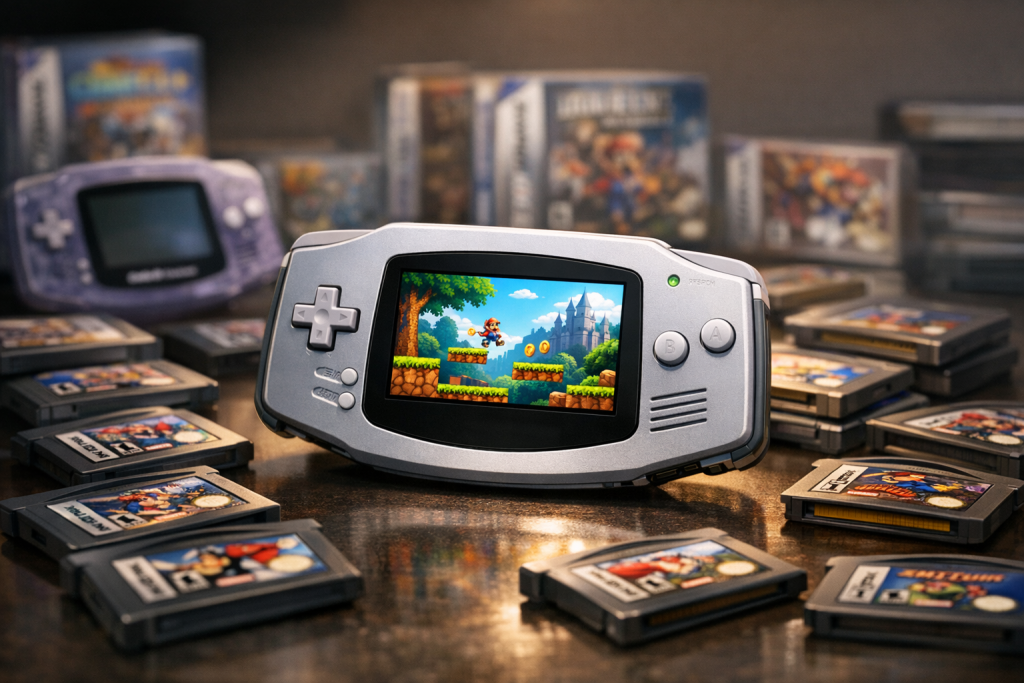
The Game Boy Advance, released by Nintendo on March 21, 2001 in Japan and June 11, 2001 in North America, sold 81.51 million units worldwide and hosted roughly 1,538 licensed games. Its 32-bit ARM7TDMI processor enabled SNES-quality visuals on a handheld, making it home to landmark RPGs, platformers, and ports that defined portable gaming for an entire generation.
The GBA’s library is widely regarded as one of the strongest handheld catalogues ever assembled. It launched alongside the Nintendo 64 era and overlapped with the GameCube generation, meaning developers had matured 2D engines and could push pixel art to its absolute peak. The system also benefited from being backward compatible with the original Game Boy and Game Boy Color, instantly inheriting decades of software heritage.
Three hardware revisions shaped the experience: the original “fat” model (2001), the Game Boy Advance SP with frontlight and later backlight (2003 and 2005), and the Game Boy Micro (2005). Each iteration improved visibility — a critical factor since the original model’s unlit screen was one of its few weaknesses. The library remained consistent across all three, and the SP in particular sold over 43 million units, becoming the most popular form factor.
What follows is a curated, ranked exploration of the finest titles ever produced for the platform, drawing on critical reception, commercial success, technical achievement, and lasting cultural influence. The list balances obvious heavyweights with overlooked masterpieces that deserve modern recognition.
The Top 10 Best GBA Games Ranked
The very best Game Boy Advance games combine technical mastery, compelling design, and replay value. The top ten consists of The Legend of Zelda: The Minish Cap, Metroid Fusion, Metroid: Zero Mission, Pokémon Emerald, Advance Wars 2: Black Hole Rising, Mario Kart: Super Circuit, Castlevania: Aria of Sorrow, Golden Sun, Fire Emblem: The Sacred Stones, and Mother 3.
1. The Legend of Zelda: The Minish Cap (2004)
Developed by Capcom’s Flagship division alongside Nintendo, The Minish Cap released in Japan in November 2004 and worldwide in early 2005. It uses the shrinking mechanic — Link can become tiny via the titular cap, Ezlo — to create dual-scale dungeons and overworld puzzles. The game runs at 240×160 resolution with rich, painterly sprite work that rivals any 16-bit Zelda. Reviewers awarded it scores in the 89–91 range on Metacritic, and it remains the highest-rated Zelda title on the platform.
2. Metroid Fusion (2002)
Released November 17, 2002, Fusion reintroduced Samus Aran after an eight-year absence following Super Metroid. Directed by Yoshio Sakamoto, it features a more linear, narrative-driven structure built around the parasitic SA-X stalking the player through the BSL research station. The atmosphere of dread is unmatched on the system, and the game pioneered the “Metroidvania” template that contemporary indie developers continue to draw from.
3. Metroid: Zero Mission (2004)
A full remake of the 1986 NES original, Zero Mission launched February 9, 2004. It added Power Grip mechanics, an expanded post-credits Chozodia sequence with stealth gameplay, and refined controls. Metacritic scored it 89/100. The visual presentation, particularly the Chozo ruins and Mother Brain encounter, represents some of the best pixel art ever produced.
4. Pokémon Emerald (2004/2005)
The definitive Hoenn-region experience, Emerald launched in Japan September 16, 2004 and in North America May 1, 2005. It refined Ruby and Sapphire with the Battle Frontier, double encounters, animated Pokémon sprites in battle, and a dual-villain storyline featuring both Team Magma and Team Aqua. It sold over 7.06 million copies globally and remains a fan-favorite generation entry point.
5. Advance Wars 2: Black Hole Rising (2003)
Intelligent Systems’ turn-based strategy sequel arrived June 23, 2003 in North America. It built on the 2001 original with new COs like Hawke, Sturm, and Sensei, plus refined campaign design across roughly 30 missions. Its accessibility and depth — terrain bonuses, fog of war, CO powers — made it a critical darling, earning a 90/100 Metacritic average.
6. Mario Kart: Super Circuit (2001)
Launched within the GBA’s first year, Super Circuit packed 20 new tracks plus all 20 tracks from the original Super Mario Kart for SNES, giving it the largest course count in series history at the time. It supported four-player multiplayer via a single cartridge through download play and sold over 5.91 million copies.
7. Castlevania: Aria of Sorrow (2003)
Koji Igarashi’s third GBA Castlevania, released May 6, 2003, introduced protagonist Soma Cruz and the Tactical Soul system, allowing players to absorb abilities from over 100 defeated enemies. Set in the year 2035, it broke from gothic conventions while preserving the Metroidvania structure perfected in Symphony of the Night.
8. Golden Sun (2001) and The Lost Age (2002)
Camelot Software Planning’s two-part RPG epic features Djinn-based class customization, elemental puzzle solving, and what may be the most technically impressive 3D-rendered summon animations on the platform. The combined narrative spans roughly 60–80 hours and uses a password/data transfer system to carry progress between cartridges.
9. Fire Emblem: The Sacred Stones (2004/2005)
The eighth Fire Emblem entry and second to release in the West, Sacred Stones arrived in Japan October 7, 2004 and North America May 23, 2005. It introduced branching class promotions, a world map with optional encounters, and the dual-protagonist twins Eirika and Ephraim. More accessible than its predecessor, it remains the friendliest entry point to classic Fire Emblem.
10. Mother 3 (2006)
Released exclusively in Japan on April 20, 2006, Shigesato Itoi’s sequel to EarthBound never received an official localization, though a fan translation patch (2008) brought it to global audiences. Its rolling HP system, rhythm-based combo attacks, and emotionally devastating eight-chapter narrative make it arguably the most artistically ambitious GBA title.
Reading on a phone? Why not playing on it?
EMUverse turns your iPhone into a powerful GBA console with HD video, save states, and custom skins.
Install Now — Free
The Best GBA RPGs in Depth
The Game Boy Advance is widely considered a golden era for portable RPGs, hosting both original masterworks and definitive ports of 16-bit classics. The platform’s library includes more than 150 RPGs spanning traditional turn-based, tactical, action, and dungeon-crawler subgenres.
Final Fantasy Tactics Advance (2003)
Yasumi Matsuno produced this Ivalice spin-off, released February 14, 2003 in Japan. Its job system spans roughly 34 classes across five races (Human, Bangaa, Nu Mou, Viera, Moogle), and the law system constrains battlefield tactics with rotating banned actions. The framing story — schoolchildren transported into a Final Fantasy world — gives it a unique tonal identity.
Final Fantasy VI Advance (2006)
Released in 2006 as the last of Square Enix’s GBA Final Fantasy ports, this version of the 1994 SNES classic added four new espers (Leviathan, Cactuar, Gilgamesh, Diabolos), the Dragon’s Den bonus dungeon, the Soul Shrine survival challenge, and a new translation by Tom Slattery. Many fans consider it the definitive way to play FFVI despite some audio compromises.
Final Fantasy IV Advance (2005) and V Advance (2006)
Both ports added new bonus dungeons, additional jobs (in V’s case), and updated translations. FFV Advance in particular added the Sealed Temple post-game dungeon and four new jobs (Gladiator, Cannoneer, Necromancer, Oracle), expanding an already deep job system.
Sword of Mana (2003)
A full remake of the 1991 Game Boy classic Final Fantasy Adventure, Sword of Mana features rebuilt art assets, an expanded class system, and dual protagonist storylines. It was directed by Shinichi Kameoka and released August 29, 2003.
Tactics Ogre: The Knight of Lodis (2001)
Quest Corporation’s prequel to the SNES original released June 21, 2001 in Japan and May 7, 2002 in North America. Its alignment system, emblem rewards, and intricate class trees provided dozens of hours of strategic depth before the studio was absorbed into Square Enix.
Summon Night: Swordcraft Story (2003/2004)
Flight-Plan’s action RPG combined weapon-forging mechanics with real-time dueling combat. Players craft swords, axes, knuckles, drills, and spears from materials collected in dungeons, creating a satisfying gameplay loop unique to the series.
The Best GBA Platformers and Action Games
Beyond its RPG strength, the GBA boasted exceptional 2D action and platforming titles, including Super Mario Advance 4: Super Mario Bros. 3, Wario Land 4, Kirby & The Amazing Mirror, Mega Man Zero 3, and Castlevania: Circle of the Moon. These represent the apex of late-era 2D design before mainstream gaming pivoted fully to 3D.
Wario Land 4 (2001)
Released August 21, 2001, this is Nintendo’s most experimental Wario platformer. Each level requires Wario to reach a goal, trigger a frog switch, then escape backward before a timer expires. The cartoonish art direction by Goro Abe pushed the GBA’s color palette and animation to extraordinary levels.
Super Mario Advance 4: Super Mario Bros. 3 (2003)
This enhanced port added e-Reader support, enabling 38 additional levels via scannable cards. It remains the only handheld version of SMB3, though the e-Reader content was lost to most players until a 2016 Wii U Virtual Console release bundled all bonus levels by default.
Kirby & The Amazing Mirror (2004)
HAL Laboratory and Flagship’s collaborative effort released April 15, 2004. Unlike traditional linear Kirby games, it presents an interconnected Metroidvania world map with four Kirby companions summoned via a cell phone. Multiplayer via Game Link Cable allowed cooperative exploration.
Mega Man Zero Series (2002–2005)
Inti Creates developed four Mega Man Zero games on the GBA, with the third installment (2004) generally regarded as the apex. The series is famous for its punishing difficulty, ranking system, cyber-elf customization, and Toru Nakayama’s striking character design. The 2020 Zero/ZX Legacy Collection made these accessible to modern audiences.
Castlevania: Harmony of Dissonance (2002) and Circle of the Moon (2001)
Together with Aria of Sorrow, these form the GBA Castlevania trilogy. Circle of the Moon launched alongside the system in 2001 with its DSS card-combination magic system. Harmony of Dissonance (2002) featured a faster engine and two overlapping castles to explore.
Drill Dozer (2005)
Game Freak — better known for Pokémon — developed this rumble-feature platformer released March 24, 2005 in Japan and February 6, 2006 in North America. The cartridge contained a built-in rumble motor, and protagonist Jill’s giant drill mech served as both weapon and traversal tool.
The Best GBA Pokémon Games
The Game Boy Advance hosted six mainline Pokémon titles: Ruby, Sapphire, FireRed, LeafGreen, Emerald, and the spinoff Pokémon Mystery Dungeon: Red Rescue Team. Combined, these games sold over 47 million copies and introduced the third generation of Pokémon (251 new species, double battles, abilities, natures, and the EV/IV system underpinning competitive play).
Pokémon FireRed and LeafGreen (2004)
Released September 9, 2004, these remakes of the 1996 originals introduced the Sevii Islands post-game region, wireless adapter support (the first Pokémon games with wireless multiplayer), and brought first-generation Pokémon forward to be compatible with the Gen 3 system. They sold approximately 12 million copies combined.
Pokémon Ruby and Sapphire (2002/2003)
The Hoenn region debut launched November 21, 2002 in Japan and March 19, 2003 in North America. Despite controversy at launch over breaking compatibility with older games, the introduction of abilities, natures, two-on-two battles, and weather mechanics permanently reshaped the franchise. Combined sales exceeded 16 million.
Pokémon Mystery Dungeon: Red Rescue Team (2005/2006)
Chunsoft developed this roguelike spinoff, released November 17, 2005 in Japan. Players become a Pokémon and explore procedurally generated dungeons. The story is surprisingly emotional, and the title launched simultaneously with a DS version (Blue Rescue Team) supporting cross-platform connectivity.
Hidden Gems and Underrated Classics
Several outstanding GBA titles flew under the radar due to limited marketing or late-cycle releases. These include Boktai: The Sun Is in Your Hand, Astro Boy: Omega Factor, Gunstar Super Heroes, Klonoa: Empire of Dreams, and Ninja Five-O, each commanding triple-digit secondary market prices today.
Boktai: The Sun Is in Your Hand (2003)
Hideo Kojima’s vampire-hunter action title shipped with a solar sensor in the cartridge, requiring real sunlight to recharge protagonist Django’s Gun del Sol. Released July 17, 2003 in Japan, it sparked a small franchise of three GBA entries. Its mechanical novelty — using real-world weather and time as gameplay variables — remains unparalleled.
Astro Boy: Omega Factor (2003/2004)
Co-developed by Treasure and Hitmaker, released December 18, 2003 in Japan. Treasure’s signature dense combat design (seen in Gunstar Heroes and Ikaruga) translates beautifully to Osamu Tezuka’s character roster. The game’s “Omega Factor” system and multiple endings encourage repeated playthroughs.
Gunstar Super Heroes (2005)
Treasure’s spiritual successor to their 1993 Genesis classic released October 6, 2005 in Japan. While shorter than the original, it features inventive boss designs, multiple weapon types, and absurdly fast-paced shoot-em-up sequences.
Ninja Five-O (2003)
Hudson Soft’s grappling-hook ninja action game released April 22, 2003. Its small print run made it one of the rarest commercial GBA titles, with sealed copies routinely selling for $500+. The grappling physics and tight level design draw comparisons to Bionic Commando.
Klonoa: Empire of Dreams (2001) and Klonoa 2: Dream Champ Tournament (2002)
Namco’s 2.5D platformer series transitioned beautifully to the GBA’s hardware. The grab-and-throw enemy mechanic translates to puzzle-platforming challenges across vibrant dream worlds.
Sigma Star Saga (2005)
WayForward and Namco’s hybrid RPG/shoot-em-up alternates between top-down exploration and randomly triggered side-scrolling space battles. A unique fusion concept that never received a sequel.
Best GBA Multiplayer and Link Cable Games
The GBA’s Game Link Cable enabled some of the era’s most innovative multiplayer experiences, supporting up to four players with a single cartridge through download play. Standout multiplayer titles include Mario Kart: Super Circuit, F-Zero: GP Legend, Bomberman Tournament, Advance Wars, and The Legend of Zelda: Four Swords.
The Legend of Zelda: Four Swords (2002)
Bundled with A Link to the Past on a single GBA cartridge released December 3, 2002, Four Swords requires 2–4 players each with their own GBA and link cable. It marked the first multiplayer Zelda game and pioneered cooperative-competitive dungeon crawling.
Bomberman Tournament (2001)
Released July 9, 2001, this title combined a single-player RPG mode with classic multiplayer Bomberman, supporting four players via link cables. Its hybrid structure provided substantial solo value alongside party gameplay.
Mario Golf: Advance Tour and Mario Tennis: Power Tour (2004/2005)
Camelot’s sports RPGs combined arcade sports with character progression, multiplayer tournaments, and GameCube connectivity to Mario Golf: Toadstool Tour and Mario Power Tennis.
Comparison Table: Top GBA Games by Genre
| Genre | Best Pick | Year | Metacritic | Approx. Sales |
|---|---|---|---|---|
| Action-Adventure | The Legend of Zelda: The Minish Cap | 2004 | 89 | 1.76M |
| Metroidvania | Metroid Fusion | 2002 | 92 | 1.07M |
| JRPG | Golden Sun | 2001 | 91 | 1.20M |
| Tactical RPG | Fire Emblem: The Sacred Stones | 2005 | 85 | 1.36M |
| Strategy | Advance Wars 2 | 2003 | 90 | 0.41M |
| Racing | Mario Kart: Super Circuit | 2001 | 93 | 5.91M |
| Platformer | Wario Land 4 | 2001 | 89 | 1.10M |
| Monster-Catching | Pokémon Emerald | 2005 | 76 | 7.06M |
| Action | Mega Man Zero 3 | 2004 | 89 | 0.20M |
| Story-driven | Mother 3 | 2006 | N/A (JP only) | 0.40M |
Best GBA Ports and Compilations
The GBA’s processing power allowed faithful reproductions of 16-bit-era classics. Notable ports include Super Mario World (as Super Mario Advance 2), The Legend of Zelda: A Link to the Past, Yoshi’s Island (as Super Mario Advance 3), Donkey Kong Country, and the various Final Fantasy ports.
The Legend of Zelda: A Link to the Past & Four Swords (2002)
This dual-pack contained an enhanced version of the SNES classic plus the multiplayer Four Swords mode. Subtle additions included new dungeons (the Palace of the Four Sword) and rebalanced audio for the GBA’s speaker limitations.
Super Mario Advance Series
Five games comprised this lineup: Super Mario Bros. 2 (2001), Super Mario World (2001), Yoshi’s Island (2002), Super Mario Bros. 3 (2003), and Mario Kart noted separately. Each added voice clips, expanded color palettes, and minor gameplay tweaks. Yoshi’s Island: Super Mario Advance 3 in particular is often cited as superior to many of the platform’s original titles thanks to its hand-drawn aesthetic translating perfectly.
Donkey Kong Country Trilogy (2003–2005)
Rare ported all three SNES Donkey Kong Country games to the GBA. While the audio suffered due to hardware constraints, the visual transfer was remarkable, and new minigames plus revised cartography added value beyond simple emulation.
Final Fantasy I & II: Dawn of Souls (2004)
This compilation released November 29, 2004 included expanded post-game content for both original NES Final Fantasy games, modernized translations, and refined balance — making it the most accessible way to experience series origins.
Common Pitfalls When Building a GBA Collection
Collectors entering the GBA market in 2024 face counterfeit cartridges, varying regional prices, and hardware degradation issues. The most common pitfalls include buying reproduction carts mislabeled as authentic, overpaying for common titles, neglecting battery-backed save replacement, and assuming all “rare” listings are genuinely scarce.
- Counterfeits: Pokémon titles especially suffer from fakes. Check the cartridge label printing quality, weight (genuine carts are slightly heavier), and the Nintendo seal embossing on the back.
- Battery saves: Pokémon Ruby, Sapphire, and Emerald used CR1616 batteries that have largely died by now. Replacing them is straightforward with a tri-wing screwdriver and basic soldering skill.
- Regional pricing: Japanese copies are often dramatically cheaper than Western releases for the same game, and the GBA is region-free for software.
- Loose vs. complete in box (CIB): CIB copies command 3–10× the price of loose carts for popular titles.
- Display variants: Original “AGB-001” models lack backlighting. The AGS-101 SP and Game Boy Micro provide the best screens for modern play.
Expert Tips for Playing GBA Games Today
Modern players have multiple legitimate options for experiencing the GBA library, including original hardware with IPS modifications, the Analogue Pocket FPGA system, Nintendo Switch Online’s Game Boy Advance app (launched February 2023), and various retro handhelds like the Anbernic and Miyoo Mini lines.
Display Modifications
IPS LCD mod kits for the original AGB-001 model and SP units cost $40–$80 and provide modern color reproduction, brightness control, and pixel-perfect scaling. The mod has become widespread enough that pre-modded systems are commonly available on enthusiast marketplaces.
Nintendo Switch Online + Expansion Pack
As of 2024, Nintendo’s subscription service includes Metroid Fusion, Mario Kart: Super Circuit, The Legend of Zelda: The Minish Cap, WarioWare, Inc.: Mega Microgame$!, Kuru Kuru Kururin, and several others, with new titles added periodically.
Analogue Pocket
Released December 2021, the Analogue Pocket uses field-programmable gate arrays (FPGAs) to recreate GBA hardware at the silicon level rather than emulating it. The result is lag-free, perfectly accurate playback with a 615 PPI display — arguably the best way to experience the library today.
The Rarest and Most Valuable GBA Games
Several GBA titles command extraordinary prices due to limited print runs, late-cycle releases, or kiosk-exclusive distribution. The rarest commercial titles include Pokémon Box: Ruby & Sapphire, Hello Kitty: Happy Party Pals, Ninja Five-O, Card e-Reader+, and tournament-exclusive cartridges like the Bookworm Demo.
- Ninja Five-O — loose copies routinely $300+, CIB $700+
- Pokémon Box: Ruby & Sapphire — a GameCube-compatible storage cartridge, $250+ loose
- Gunstar Super Heroes — $150+ CIB
- Mega Man Zero 4 — late release, $100+ loose
- Klonoa 2: Dream Champ Tournament — $200+ CIB
- Drill Dozer — limited Western release, $150+ CIB
How the GBA Library Compares to Other Handhelds
The GBA’s 1,538-game library is smaller than the Nintendo DS (1,800+) and PlayStation Portable (1,300+), but it occupies a unique position as the last great dedicated 2D handheld. Its strengths lie in pixel art platformers, traditional JRPGs, and tactical strategy — genres that later transitioned to 3D or polygonal styles on successor platforms.
Compared to the original Game Boy and Game Boy Color, the GBA represented an enormous generational leap: 32,768 simultaneous colors versus 56, a 240×160 resolution versus 160×144, and processing power roughly equivalent to a SNES. Compared to the DS, the GBA lacked dual screens, touch input, and wireless connectivity (until late peripherals), but maintained tighter focus on pure 2D craftsmanship.
Sega’s Game Gear (1990), Neo Geo Pocket Color (1998), and the Bandai WonderSwan (1999) all preceded the GBA but were dramatically outsold and outclassed. The GBA’s only meaningful competitor was Nokia’s N-Gage (2003), which sold approximately 3 million units against the GBA’s 81 million — a difference of nearly 27 to 1.
Frequently Asked Questions
What is considered the single best GBA game ever made?
Critical consensus tends to place either The Legend of Zelda: The Minish Cap or Metroid Fusion at the top, with both scoring 89–92 on Metacritic. Minish Cap wins for many due to its complete artistic vision, while Fusion earns the spot for its atmospheric tension and pioneering Metroidvania design. Pokémon Emerald commercially outsold both by a significant margin, but quality and influence generally favor the two Nintendo first-party action-adventure titles.
How many GBA games were released in total?
Approximately 1,538 licensed games were released for the Game Boy Advance across all regions between 2001 and 2008. Japan received the most exclusives, particularly licensed manga adaptations and dating sims. The final officially licensed GBA release was Samurai Deeper Kyo in Europe in early 2008, though the system was effectively discontinued in 2010 when Nintendo halted production of the Game Boy Micro.
Are GBA games still being made today?
Nintendo officially ended GBA production in 2010, but homebrew developers actively produce new GBA games through tools like the devkitARM toolchain and HAM software development kit. Notable modern homebrew titles include Goodboy Galaxy (2023), which raised over £100,000 on Kickstarter, and Anguna. These often release as flashable ROMs or physical cartridges through specialty publishers like Catskull Games and Incube8 Games.
Which Pokémon GBA game is the best?
Pokémon Emerald is generally considered the best of the six GBA Pokémon titles thanks to its Battle Frontier post-game content, expanded storyline incorporating both Team Magma and Team Aqua, and animated battle sprites. FireRed and LeafGreen are excellent alternatives for players seeking the original Kanto adventure with modern Gen 3 mechanics. Ruby and Sapphire are now considered redundant given Emerald‘s improvements.
Can the Game Boy Advance play original Game Boy and Game Boy Color games?
Yes. The GBA contains a complete Game Boy Color processor (Sharp LR35902 / Z80 derivative) for full backward compatibility with both original Game Boy (1989) and Game Boy Color (1998) cartridges. This effectively gave the GBA access to over 1,000 additional games at launch. The Game Boy Micro is the only model without this backward compatibility, as Nintendo removed the legacy hardware to reduce the unit’s size.
What’s the difference between the GBA, GBA SP, and Game Boy Micro?
The original GBA (2001) is a horizontal unit with an unlit reflective screen. The GBA SP (2003) folds clamshell-style and added a frontlit screen, later upgraded to a brighter backlight in the AGS-101 revision (2005). The Game Boy Micro (2005) is the smallest model — roughly the size of an original NES controller — with a bright backlit screen but no headphone jack (without an adapter) and no Game Boy/Color backward compatibility.
Is Mother 3 worth playing if I haven’t played EarthBound?
Mother 3 works as a standalone experience, but playing EarthBound first significantly enhances emotional resonance with returning characters and thematic callbacks. Since Mother 3 was never officially localized, English-speaking players must use the well-regarded fan translation patch released in 2008 by Tomato and Reidman. The game’s eight-chapter structure, rolling HP combat system, and rhythm-based combo attacks make it mechanically distinct from its predecessor.
Are GBA emulators legal to use?
The emulator software itself (mGBA, VisualBoyAdvance, etc.) is legal in most jurisdictions, having been established through cases like Sony v. Connectix (2000). However, downloading ROM files for games you don’t own is generally considered copyright infringement. Legitimate options for playing the GBA library include Nintendo Switch Online’s GBA app, dumping ROMs from your own legally purchased cartridges using devices like the GB Operator, or buying digital releases on platforms like the Wii U Virtual Console (for systems that retain access).
Ready to start playing?
Download EMUverse on the App Store and bring your retro library back to life.
Download EMUverse